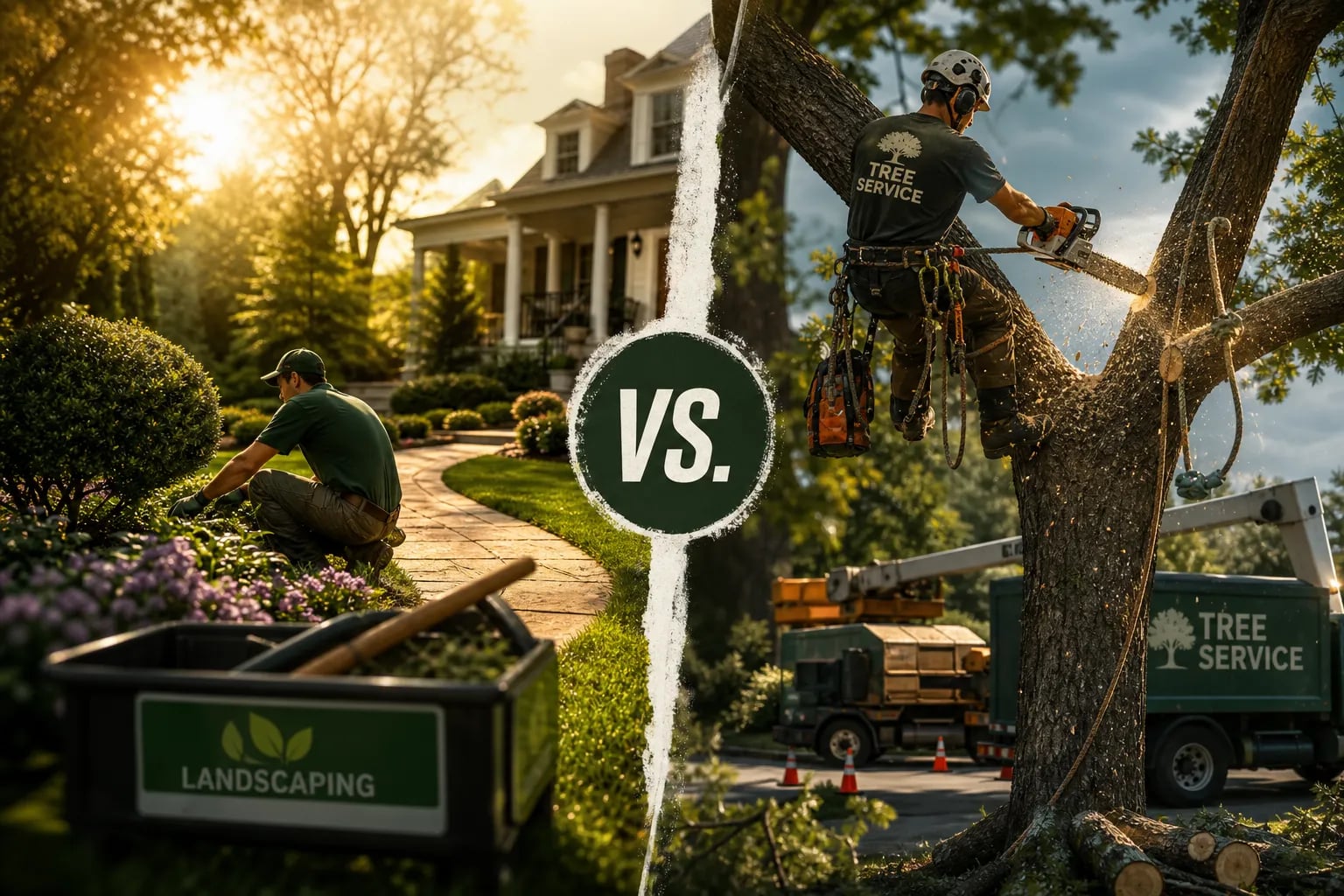
Landscaper vs. Pro Tree Service: Which One Should You Hire?

Edited & Published by Certified Arborist Dan Riggs

Your regular landscaping crew might offer to remove that large tree in your yard for a few hundred dollars. But the quote from the pro tree service in town is three times the cost. It might be tempting to just hire whoever is already on your property to save money. But when weighing the decision between landscaper vs. pro tree service, the choice gets clearer pretty quickly once you break down what you’re actually comparing (and the risks in making the wrong decision).

The gap between a landscaper and a professional tree service isn’t just a difference in price. It’s the difference in training, equipment, insurance, and the legal liability placed upon you if something goes wrong. For homeowners in Scottsdale, Paradise Valley, and the greater Phoenix area, the stakes are higher than average: desert trees like Mesquite, Palo Verde, and Eucalyptus behave differently than trees in other climates, and monsoon season and Arizona’s winter storms don’t care what (or who) is under a cracked branch. This article discusses exactly who should be making that call, and how to hire confidently after making your decision.

What Landscapers Are Actually Hired to Do

Landscapers can provide valuable work for your property, if you need your lawn mowed or your hedges trimmed. A reliable landscaping crew can keep your property looking sharp week to week, and that’s usually what they are able to do.

However, professional landscapers will stop the moment a tree gets large, structural, or complicated. Some crews can handle light cosmetic trimming on small ornamental trees, which is what a large, professional landscaping service is trained to do. But mature trees, structural crown work, heavy limb removal, and anything regarding tree health assessment are outside most landscaper abilities. Very few landscapers hold ISA certification, which may show a lack of commitment to their profession. And there’s an important distinction between tidying up a yard and properly pruning (or removing) a tree.

Landscaper vs. Pro Tree Service: Training, Equipment & Insurance

The ISA Certified Arborist credential is the benchmark for a professional tree care service in the United States. Earning it requires 5 years of documented arboriculture experience, passing a 200-question written exam, and ongoing continuing education classes to maintain active certification. The International Society of Arboriculture makes certification numbers publicly searchable, so you can verify any Arborist’s credentials before signing a contract. Any professional tree service company will have at least one Certified Arborist on staff, who is able to answer any questions or concerns that a property owner may have. And if you solicit a bid from a tree care company without a Certified Arborist on staff, it’s possible that the company is a landscaper dressed up as a pro tree service.

Equipment That Separates Landscapers from Pro Tree Service
Tree-Removal-Scottsdale-AZ-1200x900.JPG

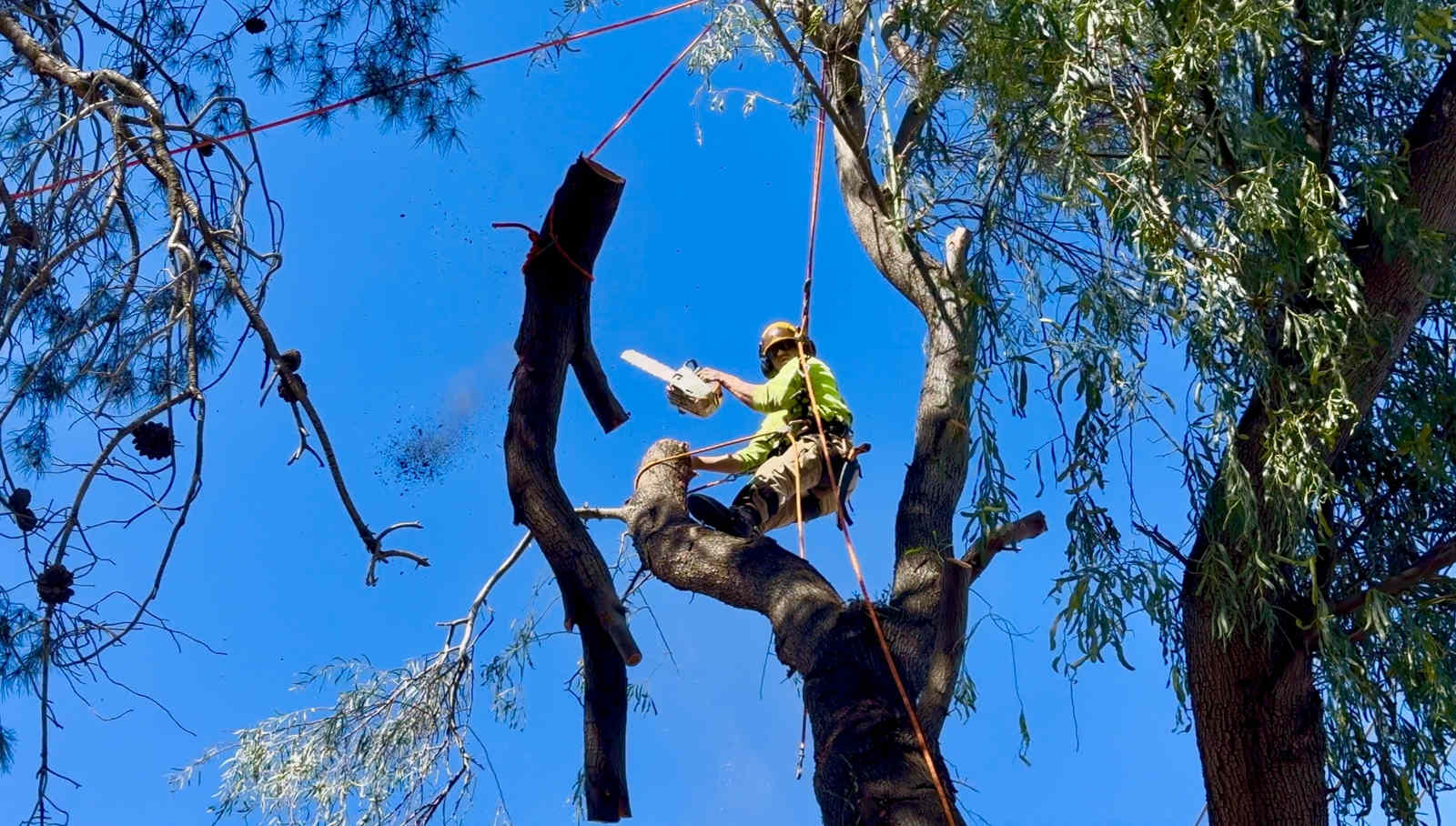
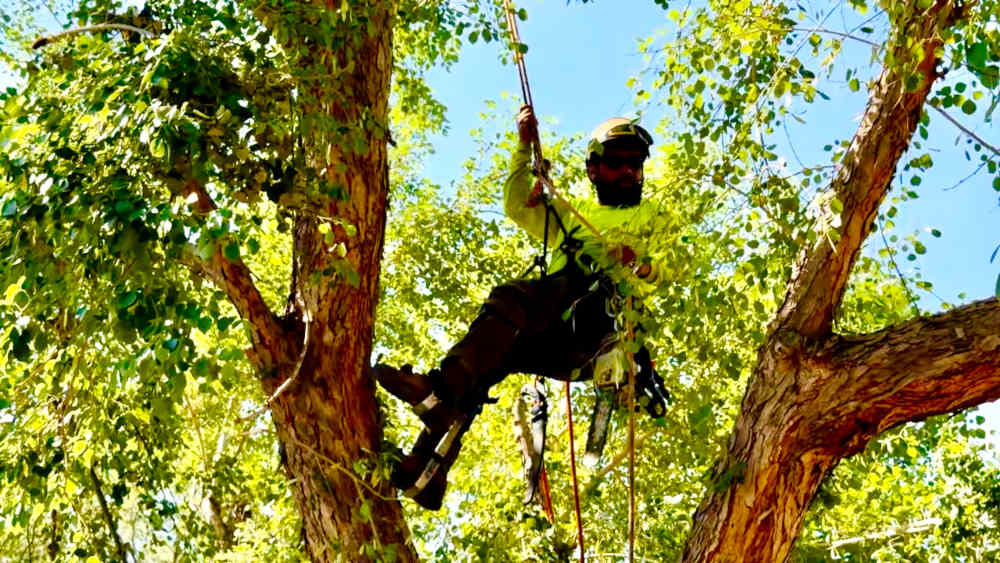
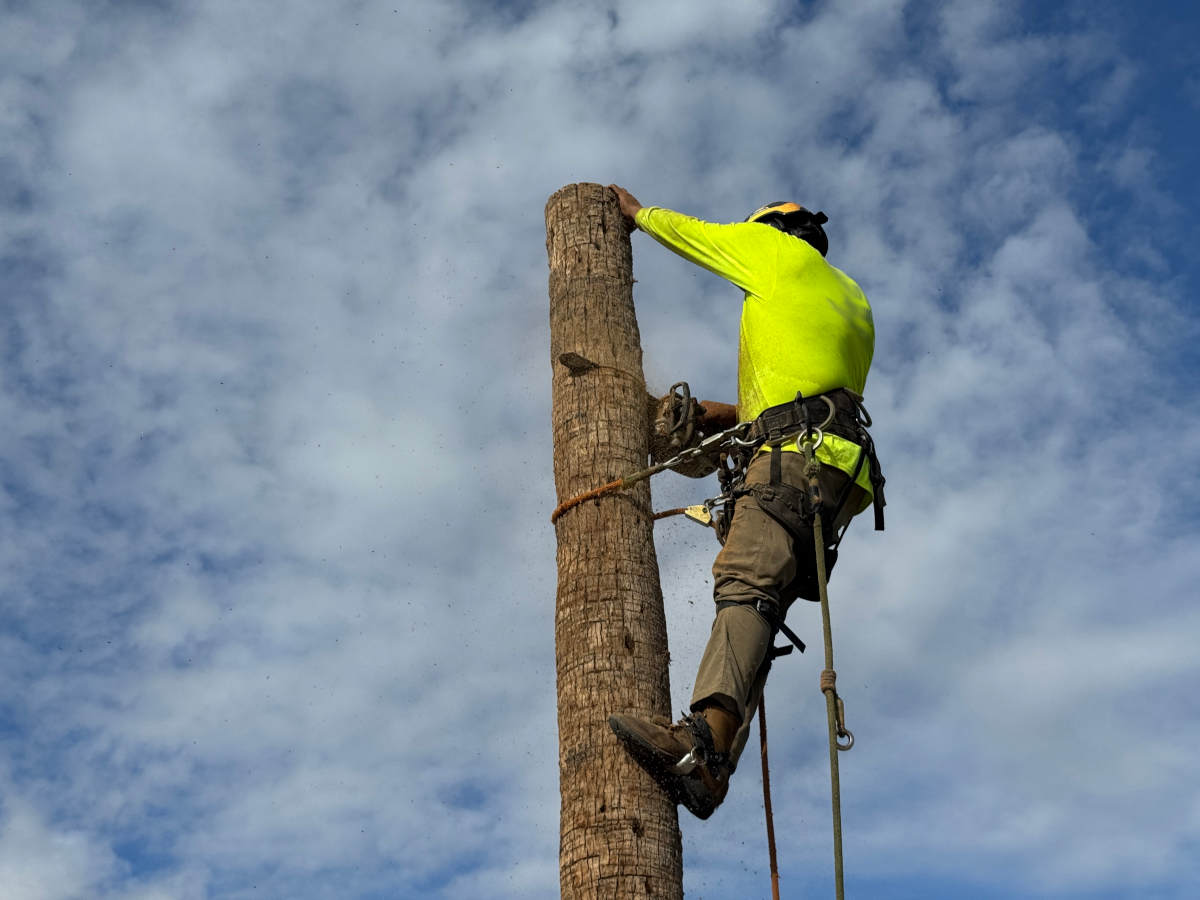
Equipment is another major dividing line. Large tree work may require aerial lifts, cranes to assist in tree removal for large or dangerous trees, and rope rigging systems to control where logs are lowered. Also commercial-grade wood chippers, and Arborist-specific PPE such as helmets and work boots. And this gear isn’t about convenience; it’s what allows crews to work safely near structures, rooflines, and fencing without causing property damage. Many professional tree services treat crane-assisted removal and complex rope rigging as standard methods for difficult residential and commercial jobs, not just a last-resort option.

The Safety and Liability Gap No Homeowner Should Overlook

Tree care is consistently ranked among the most dangerous occupations in the United States. The hazards on a large-tree service job are specific and serious: falls from height, injuries from falling branches, chainsaw accidents, and electrocution risk near power lines. And these aren’t just abstract statistics that only apply to commercial logging operations. They apply to the residential job in your backyard, with a crew that may or may not be equipped and trained to manage these risks.

The liability question is the most important. If a landscaper without proper insurance drops a limb through your roof or a worker gets hurt on your property, you may be stuck with the bill, if there isn’t Liability Insurance or Workers’ Compensation coverage in place. Before any tree work begins, request a certificate of general liability insurance sent directly from the insurer, not a document handed to you by the crew. Also, ask separately for proof of current workers’ compensation insurance coverage. Reputable tree companies will provide proof upon request, and ask their insurer to send the certificate directly to you. A contractor who pushes back on this request is telling you everything you need to know.

The injury risk scales with tree size, proximity to structures, and complexity of the job. A storm-damaged tree with a split trunk hanging over your pool carries a very different risk profile than trimming a hedge along your driveway. Treat the insurance verification process as a non-negotiable step, not an optional formality.

Tree Conditions That Call for Tree Pros, Not a Landscaper
Tree-Trimming-Scottsdale-AZ-1000x750.JPG

Certain conditions put a job firmly in pro tree service territory, regardless of what the landscaping crew says they are capable of. Disease symptoms are the first category: unusual leaf drop, bark discoloration or splitting, fungal growth near the base, dying branches throughout the crown, and oozing sap or gummosis. In Arizona’s desert climate, these signs are sometimes dismissed as heat stress, but they might indicate root rot, vascular disease, or pest damage that requires a trained diagnosis to treat or address safely.

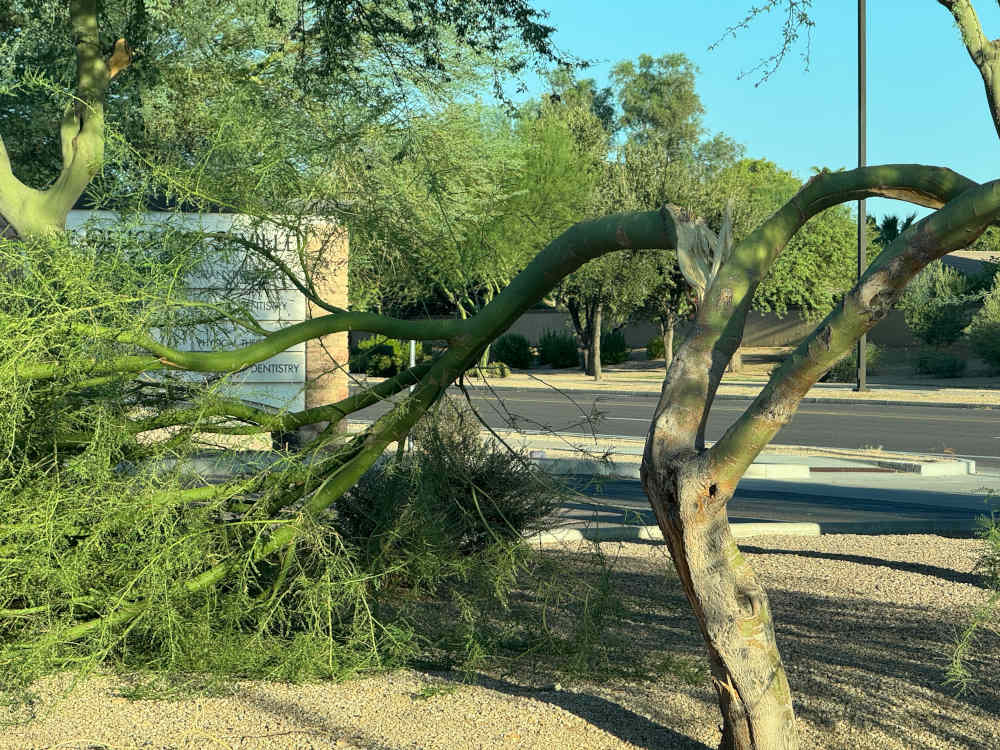
Structural issues are the second category, and these carry the most immediate physical risk. Visible cracks in major limbs, a tree that is leaning, heaving soil within the root zone, cavities in the trunk, or branches failing without warning all signal that the tree may be in decline. These conditions require assessment from a professional tree service, not just a confident-sounding estimate from a guy with a chainsaw.

The high-risk scenarios that specifically require a professional tree service include:

  • Trees with branches hanging over a roof, pool, fence line, or vehicle
  • Storm-damaged trees with unpredictable structural failure points
  • Large trees where rigging is required to control where logs are lowered with rope rigging
  • Trees with root systems near a foundation or hardscape
  • Any job requiring climbing or aerial lift access

Each of these scenarios requires not just skill, but also proper insurance coverage for the actual risks involved. A landscaper’s general liability policy rarely covers this scope of work.

Cost Comparison: Landscaper vs. Pro Tree Service

Professional tree work costs more than landscaper pricing for the same job, and the reasons are obvious. Standard tree pruning may cost between $400 to $800 per tree for typical residential work, with complex or large tree jobs costing more. Full tree removal might range between $450 to $1,200 on average, with large or difficult tree removals exceeding $2,000. Also, stump grinding service is usually quoted separately, and averages between $75 to $500 per stump, depending on the diameter. Emergency tree removal after storm damage can reach $2,000 or more when access is limited and the tree is unstable. These figures reflect national averages, but will vary by region, tree size, tree species and site conditions.

Landscaper pricing often comes in much lower because it doesn’t account for the equipment, insurance premiums, or credentialed oversight that professional tree services carry as fixed overhead costs. And it reflects a genuinely different cost structure for genuinely different capabilities.

The more useful comparison isn’t bid A versus bid B. It’s total risk versus total cost. Hiring a fully insured professional tree service eliminates financial risk, but homeowners should still verify coverage types, limits, and exclusions with the insurer directly. The upfront savings on the cheaper bid can disappear very quickly if something goes wrong, and in large-tree service work, there is always that risk by hiring a landscaping company.

What to Ask Any Company Before You Hire

There are four questions that separate qualified tree services from landscapers, and each one targets something that matters: credentials, insurance, standards, and job-specific experience. Walk through these before committing to anyone.

  1. Can you provide your ISA Certified Arborist’s number for verification? The ISA’s online tool lets you confirm that a credential is active (and not expired). A legitimate Arborist will give you this information without hesitation.
  1. Can your insurer send me a certificate of liability and workers’ compensation coverage directly? The key word is “directly.” Certificates that are handed to you by the crew can be outdated, altered or even fake. Ask the insurer to send it to you directly. Then confirm the coverage limits and policy details versus what was told to you by the tree service representative.
  1. What safety precautions does your company take? A pro tree service will always use safety practices on the job. A tree service company that focuses on safety is operating at the professional standard that your job requires.
  1. Which jobs have you done this specific type of work before? Diseased removals, crane work, storm damage, large trunks over a structure: each has its own risk profile. Ask the tree service representative you meet with to describe jobs they’ve performed that are similar to yours, and what safety precautions were taken.

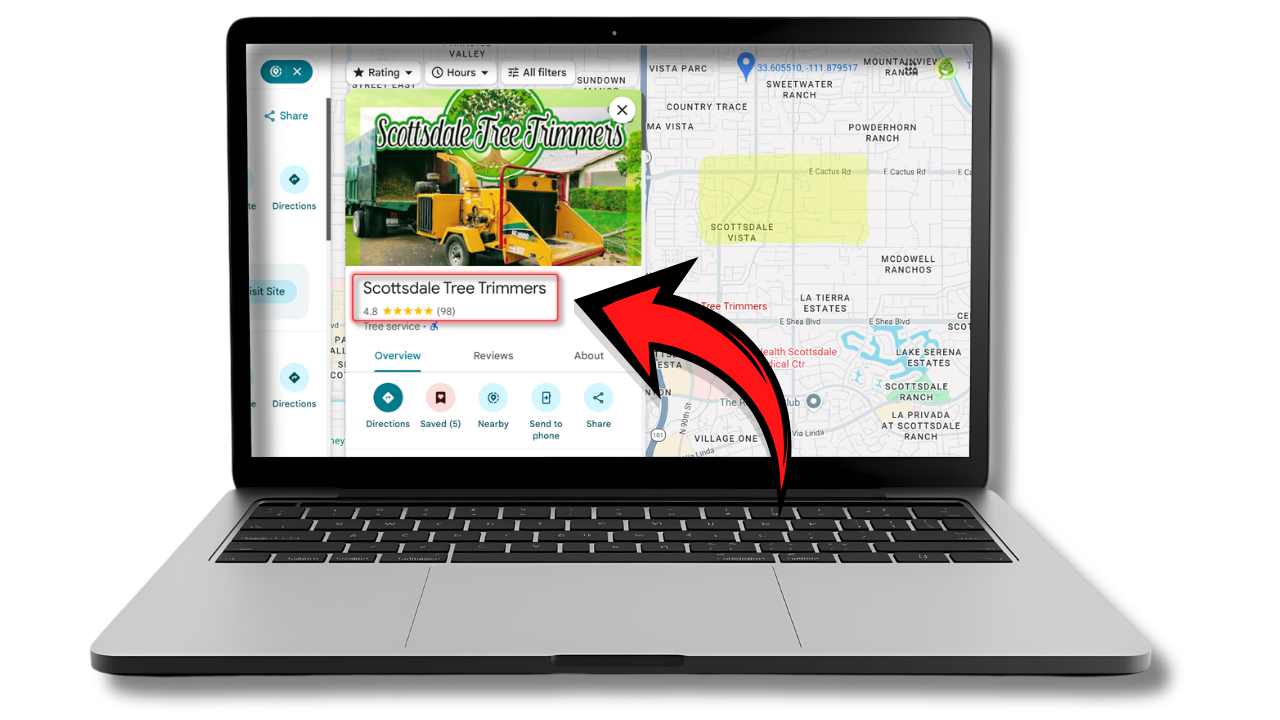
When you’re uncertain about any part of this process, get a professional assessment first. Scottsdale Tree Trimmers offers free quotes with no obligation, and a tree service professional will walk you through exactly what the job involves before you’ve committed to anything. This assurance gives you real information to evaluate every other bid that you receive, rather than comparing prices without understanding the risks of accepting the lowest bid for your tree service project.

The Bottom Line on Who to Hire

For routine yard and landscape maintenance, a landscaper might be the right person to call. But for anything involving tree structure, tree health, safety near structures, or large tree removal, a professional tree service with multiple types of insurance is the only safe choice. And the gap between these two types of companies isn’t primarily about price. It’s about training, equipment, liability coverage, and what happens if a landscaper damages property (or gets hurt) on your job.

When deciding landscaper vs. pro tree service for trees or high-risk work, always choose an experienced, fully insured team. For homeowners in Scottsdale, Paradise Valley, and the greater Phoenix area, Scottsdale Tree Trimmers offers free quotes and employs ISA-Certified Arborists on staff with deep desert-specific tree experience. From routine crown cleaning on a Palo Verde to crane-assisted removal of a storm-damaged Eucalyptus threatening your home, the team is built to handle any tree issues on your property. Get a professional assessment by calling (480) 435-2226 before you commit to any company. The estimate is free, and it gives you the proper information to make the right call.

How to Hire a Tree Service: What Every Homeowner Should Know

Edited & Published by Certified Arborist Dan Riggs

Imagine this: a strong monsoon storm blew through last night, and now the tree in your yard is now on top of your roof. Or the big Saguaro cactus that’s been slowly leaning for several years finally fell onto the car parked in your driveway. You might hop on Google, search for a tree service near you, get a few quotes, and naturally want to choose the lowest priced estimate. But that’s the moment when things usually start to go wrong.

At Scottsdale Tree Trimmers, we’ve taken plenty of calls from homeowners who hired the wrong tree service company from the start. We’ve heard reports about roof damage from a botched tree removal, an unpaid Workers’ Comp claim that landed on their homeowner’s insurance, or trees that were topped and damaged instead of properly pruned. But none of those things had to happen. This guide covers exactly what a full-service tree care company should offer, and which credentials are important to verify. We’ll also discuss how tree service pricing actually works, and what questions to ask before the tree service company arrives at your property.

What a full-service tree care company should offer

Unfortunately, not every company that calls itself a tree service has the proper equipment, or experience. Also, landscapers pretending to be tree care companies cannot provide the full scope of care your trees may need. And before you compare quotes for tree service, it’s important to understand what services a qualified tree care company should be able to provide.

Tree trimming and structural pruning are not the same service. Trimming removes dead, crossed or overgrown branches for safety and appearance. However, structural pruning improves a tree’s architecture over time for long-term safety and health. And structural pruning requires a tree service professionals with proper experience, not a landscaper with a chainsaw. In desert climates like Scottsdale Az, structural pruning matters more than many homeowners might realize. Local tree service professionals know how to prune desert species like Mesquite and Palo Verde, and have the knowledge to best prepare your trees for monsoons and winter storms.

Tree removal service is appropriate when a tree is dead, diseased beyond recovery, structurally compromised, or growing in a dangerous position on your property. A proper removal often involves aerial work platforms, cranes, or rope rigging in tight areas, and the heavy equipment required varies by the job. There’s also one detail that homeowners sometimes overlook: stump grinding is a separate service. A tree stump that is left behind can become a magnet for pests and a tripping hazard that might remain in your yard for decades to come.

Health assessments and formal tree risk evaluations are a category all their own, and should be performed by a Certified Arborist. A qualified tree risk assessment looks at root stability, canopy structure, signs of internal decay, drought stress indicators, and signs of disease in the crown, leader branches, and the bark of your tree. But this is specifically a job for a Certified Arborist. A landscaping crew not only lacks the proper training, but also the Arborist certification to give you expert advice as to whether a tree is safe to keep. Unfortunately, emergency tree removal is often the sad outcome when a crucial tree assessment is ignored for too long.

In the harsh desert climate of the Phoenix metro area, cactus removal is also a service that belongs on this list. Saguaro removal requires properly trained workers, because removing a Saguaro cactus without training can become deadly. And a company that’s been operating in Scottsdale Az for many years knows this process well; but a crew that drove in from out of state after a storm simply does not.

Choosing a Tree Service: Credentials That Actually Matter

Proper credentials can tell you whether the person making decisions about your trees actually has professional training, and is the easiest way to separate professional Arborists from a landscaper with a chainsaw and a pickup truck.

ISA Certified Arborist

The ISA Certified Arborist credential is the benchmark. ISA (the International Society of Arboriculture) offers this voluntary, ANAB-accredited certification to individuals who pass a rigorous exam covering subjects such as arboricultural science, tree biology, pruning standards, and risk management. And you can verify any Arborist’s credentials directly through ISA’s Find an Arborist directory, where you can confirm their name, credential status, and expiration date of their certification.

Proper Insurance is Crucial to Protect Your Property

Tree-Service-Insurance.jpg

Insurance is non-negotiable, and verbal assurances don’t count. Feel free to ask for a Certificate of Insurance directly from the insurer, not a document that the company prepared themselves. Industry guidance consistently recommends requesting the “COI” from the insurer or agent so you can confirm coverage dates and insurance limits. At a minimum, you need to confirm General Liability coverage (covering property damage) and Workers’ Compensation insurance (for potential crew injuries on your jobsite). If a crew member is injured on your property and the company doesn’t carry proper Workers’ Comp insurance, that liability can land on your homeowner’s insurance policy. And this isn’t just a hypothetical statement. Unfortunately, situations like this actually happen. It is a far too common occurrence that a fly-by-night landscaper gets hurt on a customer’s property without Worker’s Comp, and then hires an attorney to sue the homeowner. And most homeowners have no idea that this story happens far too often. So please, don’t risk landing in court after hiring a bargain priced landscaper that puts your property (and family) at risk.

How tree service pricing actually breaks down

Pricing for tree work makes sense once you understand the variables, and the numerous costs incurred by a professional tree service. Here are the 2026 national averages for the most common tree services:

  • Tree removal: National averages are around $750, with typical ranges of $400 to $1,200 for residential tree removal service for trees of average size. In larger metro areas or for complex high-risk tree removals, prices can reach $3,000 or more.
  • Tree trimming and pruning: National average falls between $430 to $970 for medium sized trees, but increase with tree height and the complexity of the tree’s canopy.
  • Stump grinding service: Typically between $150 to $475, usually priced by stump diameter, height above ground level, tree species, and how long the stump has remained in the ground following tree removal service.

In the Scottsdale Az and Phoenix market, tree removal typically ranges between $500 to $900 for a medium sized residential tree, with trimming often ranging between $250 to $885 per tree. Small, easy to access trees are often at the lower end of the range, while very large tree removals near structures or jobs requiring a crane may exceed $2,000.

If your tree service quotes vary dramatically, that gap between prices should be telling you something that is obvious. A suspiciously low bid usually reflects a lack of insurance, workers with little experience, or no plan to haul away debris, disposal and stump grinding. By getting several bids, you can determine the market rate for professional tree service. And when one quote is higher than the others, it’s okay to ask why. A reputable tree care company will explain the variables in quote pricing without hesitation.

Tree Service Red Flags to Watch Out For

Unfortunately, the storm-chaser scenario plays out every monsoon season across the Phoenix metro area. A truck drives in the morning after a storm, a stranger knocks on your door, offers to handle everything on the spot, and always asks for cash. But know that legitimate tree companies don’t operate this way. Pro tree services book jobs through referrals and their existing client base, not by driving through neighborhoods after a severe storm. Companies that show up uninvited after storms are rarely insured, and transfer the liability of the tree work to the homeowner who has already suffered a loss. This leaves you, the homeowner, with little recourse if something goes wrong.

Also, beware of verbal quotes and handshake agreements that leave you with absolutely no protection. A professional tree removal service provides written, itemized estimates that cover the full scope of tree service work: which trees, what services, whether debris removal is included, and how stumps are handled following tree removal. Also, the total cost of the tree service will be clearly written, and a pro tree service never charges extra if a job takes longer than expected. In addition, if the final invoice looks different from the conversation you had with that shady company, a verbal agreement leaves you unprotected.

Any hesitation about insurance documentation is a firm reason to say “no”. If you want to be fully protected, ask for a Certificate of Insurance. A legitimate company will always be able to provide proof of Liability and Worker’s Comp insurance. If a company stalls, claims the paperwork is “in the truck,” or asks you to simply trust them, it’s time to call a reputable tree service instead.

Questions to ask before you sign anything

A few direct questions, asked upfront, will tell you more about a company than any website or brochure could ever provide. Proper answers come quickly and without hesitation. Before any tree care company starts work on your property, ask:

  • Can you provide a Certificate of Insurance for both General Liability and Workers’ Compensation insurance?
  • How long have you been operating in this area?
  • Is debris removal and disposal included, or is it billed separately?
  • What equipment will you use, and what type of access to my yard is required?
  • What precautions will be taken to protect surrounding landscaping and structures during the tree service work?

Any tree company worth hiring will answer every one of those questions without hesitation. However, vague answers and pushback regarding basic verification questions will tell you everything that you need to know.

Why local expertise consistently outperforms a low bid

A national franchise (think Sav-A-Tree, Bartlett or Davey) or an out-of-area crew can show up with heavy equipment and a competitive price, but they can’t replicate years of working in the specific desert climate of Scottsdale Arizona. Understanding how drought affects tree health and safety, how to prevent damage to irrigation lines during a removal, or understanding Scottsdale’s native tree species isn’t general knowledge. It’s local knowledge, built upon years of professionally performing tree service work in the Scottsdale market.

We’ve been serving Scottsdale, Paradise Valley, and the greater Phoenix area for nearly two decades. We have Certified Arborists on staff for every job that requires a health assessment, risk evaluation or proper advice for how to care for your valuable (and expensive) trees. We’re fully insured, operate with professional equipment including aerial work platforms and cranes, and can handle potentially dangerous cactus removal with our experienced tree service crews. Feel free to give us a call for a free, no-obligation quote, and let us show you what that local experience looks like in practice.

Knowing what to look for means fewer surprises

Tree-Service-Scottsdale-Az-1280x720.jpg

By verifying proper insurance and reading real customer reviews, you can separate a tree service worth hiring from one that may cause new problems. A reputable tree care company won’t pressure you, will put everything in writing, and will answer your questions directly without any pushback or hesitation.

Whether you need a diseased tree evaluated before it becomes a liability or a storm-damaged branch removed before it causes property damage, your qualification and hiring process can help protect you from larger problems. If you’re in the Scottsdale Az area and want a no-obligation quote from a local tree service that’s been performing tree service work for nearly 20 years, reach out to Scottsdale Tree Trimmers at (480) 435-2226 to schedule your free quote for tree service!

Tree Trimming: Costs, Timing, and How to Hire the Right Tree Service

Edited & Published by Certified Arborist Dan Riggs

Tree trimming is a service that most homeowners only think about after something goes wrong. You might look up at the canopy of your tree when a large branch breaks and nearly hits your car, and again after the next monsoon storm rolls through Phoenix and ravages your tree. And when this happens, a lot of questions may come to mind: Does my tree need trimming? Did I wait too long to call a tree service? What is this tree trimming service going to cost? Those are all great questions, but they may have been asked too late.

And it might not come as a surprise that tree trimming rewards planning ahead. When you know what the tree service work actually involves, what it should cost in 2026, and what to verify before hiring professionals, you can make a confident decision from the start. This is a much better approach as opposed to calling the first company that shows up in a search for a tree service near me. This tree trimming guide covers it all, from the difference between a light shaping and a crown reduction, to the credentials that separate a qualified tree service from a landscaper with a chainsaw. Throughout, we’ll reference how companies like Scottsdale Tree Trimmers, a family-owned tree service serving the Phoenix metro area, handles these decisions day to day, as a model for what professional, properly insured tree care service looks like.

What Tree Trimming Service Covers

“Tree trimming” sometimes gets used as a catch-all term, but the work that’s required depends greatly on the tree’s size, species, condition, health and what you’re trying to accomplish. By understanding the scope of tree work that’s needed, it helps you evaluate quotes accurately and know what a crew should and shouldn’t be doing while trimming your trees.

From Canopy Shaping to Crown Reduction to Thinning

Tree trimming can mean several different things: crown cleaning, thinning, structuring, removing crossing or rubbing branches, and pruning away from roofs and property lines. Crown cleaning involves removing dead, cracked or broken branches to improve airflow and reduce tip weight. However, crown reduction is a much more involved process. Crown reduction can bring a large, overgrown canopy back into proportion by selectively cutting back leader branches while preserving the tree’s natural structure. Structural pruning, often performed on younger trees or trees with safety hazards, can promote a strong leader branch structure so that problems don’t compound over time.

The terms “tree pruning” and “tree trimming” are used interchangeably in most conversations related to trimming trees. Regardless of which term your tree service company decides to use, they mean the same thing. Some HOA requirements may even use one term over the other, but the distinction matters less than understanding the specific needs of your tree.

When to Schedule Tree Trimming and How Often

Trimming at the wrong time of year can stress a tree, invite pests, or trigger an early onset of disease or infection. But don’t be alarmed, because in the desert environments of Scottsdale, Paradise Valley and Phoenix Az, choosing the proper time of year for pruning is important for only a few different species of trees. Now, this advice may be contrary to 90% of the advice available online, because most of the trees in our country are not planted in the desert.

Seasonal Timing Might Not Apply to Your Trees

The general rule for routine tree maintenance is to prune during dormancy, but that advice applies to Deciduous trees. However, if your tree is showing a structural problem, too thick of a crown, or is causing problems on your property, it’s always better to solve a small problem before that problem becomes much worse. For Citrus trees, try to avoid trimming or thinning during the hottest part of the summer, unless the pruning work is corrective. This is due to a couple different reasons that relate to trimming Citrus trees. The first is that Citrus trees have much weaker immune systems than native desert varieties such as Palo Verde or Mesquite trees. Another reason is that Citrus trees have some of the thinnest bark of any tree that will survive in desert climates. And if new sections of the paper-thin bark of a Citrus tree are exposed to the westward sun during extreme temperatures, a mature Citrus tree with a weakened immune system may suffer. It is common for Citrus trees to have peeling bark caused by sunscald or sun scorch, but the fewer problem areas with your Citrus tree, the better.

How Often Different Trees Need Professional Attention

Southern Live Oak and Silk Oak trees typically need professional trimming every two to three years, because they grow much slower than most other species. Pines trees such as Aleppo, Mondell, Eldarica, Syrian or Afghan are also slow growing species that typically need attention every two to five years. Fruit trees such as the many varieties of Citrus will benefit from annual pruning while young, then at least every two years as they mature. Trees that are growing near homes, power lines or roofs and patios often need attention more frequently, to help prevent future problems and property damage. Also, the condition of your tree and it’s location on your property may influence how often your trees need pruning.

Tree Trimming Cost: What to Expect in 2026

Cost uncertainty is something that most people are curious about prior to contacting a professional tree service. National averages for 2026 can give you a useful starting point, but just remember that the final price depends on tree size, species, access, and exactly which tree services are involved.

Per-Tree Trimming Pricing and What Affects the Final Cost

Across the U.S., professional tree trimming can cost as little as $75 for a small, newly planted tree and as high as to $2,000 or more for a giant tree that has never been professionally pruned. A small tree planted in an open yard will be toward the lower end of that scale. However, a large or complex tree with tight access, a complicated crown structure or proximity to houses or fragile property are usually at the higher end. Hourly crew rates typically fall between $300 to $400 per crew-hour, which includes many different costs. Some of the expenses included in the crew-hour cost are labor for a 3 to 4 man crew, equipment costs, liability insurance, worker’s compensation insurance, and haul away and environmentally friendly disposal of the tree debris. And if you need tree services that require extra expertise, the typical rate for a Certified Arborist is usually $100 to $250 per hour for specialized assessments, or complex work or Deep Root Fertilization.

How Much Individual Tree Services Cost on Their Own

Crown reduction or complex structuring is the most expensive individual service, usually costing anywhere between $500 for medium sized trees and up to $2,000+ for very large or old growth trees. But, these costs heavily depend on your tree’s size and the complexity of the tree trimming service required. If removal of deadwood in the crown is needed, it typically costs between $150 to $400 for smaller trees and $400 to $900 for medium-sized trees. This might sound expensive just for removing lots of small dead branches, however, deadwood pruning can be an incredibly time consuming process for the tree trimming service crew. Also, when multiple tree services are bundled into a single tree service project, the overall quote is almost always more cost-effective than booking each tree service separately.

How to Spot Bad Pruning Before It Damages Your Trees

The damage from poor tree trimming doesn’t always show up immediately after the tree work has been finished. Sometimes it takes a season or two before a homeowner realizes that the tree pruning crew they hired made cuts that will cost the tree years of health and structural integrity. This is why it is crucial to hire a professional tree trimming service to prune your valuable trees, and never a landscaper.

Visible Signs a Tree Was Trimmed Improperly

If branch stubs are left within your tree’s crown, it can prevent proper healing and invite rot. And the opposite is also true. If flush cuts are made too close to the trunk by pruning off the branch collars (the slightly raised tissue between a leader branch and its parent branch or trunk) this can cause dieback beneath the flush cut. Also, “topping” a tree without a specific reason can be one of the most damaging practices in all of arboriculture. The International Society of Arboriculture classifies topping as an unacceptable pruning practice, and the long-term structural damage that can be caused is well documented. Water sprouts (the dense clusters of thin upright shoots that grow from improper pruning cuts) are a typical sign that a tree was topped or pruned improperly. And practices such as over-thinning in a single session can remove too much of the crown and may trigger stress responses, sunscald, and a compromised immune system.

Long-Term Damage from Improper Cuts

Decay can enter the vascular system of a tree through poorly made cuts, and may spread into living wood. Also, a tree’s branch structure can weaken over time if proper pruning practices are ignored. In addition, the regrowth that follows bad tree pruning service is often weakly attached and more likely to fail during strong winds or monsoon storms. Trees that have been topped or severely over-pruned can become more vulnerable to pests and disease, and in extreme cases, the structural damage may become permanent. Corrective tree pruning service can slow the decline of a poorly trimmed tree, but it may take years and multiple tree trimming service visits to reverse the damage. Too many homeowners choose to pay a lower price upfront for unqualified work by landscapers or a mom-and-pop tree service, and end up regretting their decision. This lapse in judgement often ends up costing far more to reverse through future corrective pruning practices than the job would have cost if it was performed by a professional tree trimming service.

What to Look for When Hiring a Professional Tree Trimming Service

Tree-Trimming-Scottsdale-1600x908.jpg

Hiring the right tree trimming crew is one of the most important decisions that a homeowner can make. The following are a few things to verify before you allow a company onto your property with a chainsaw.

Insurance You Should Always Verify Before Any Work Begins

Always make sure to ask for proof of general liability insurance and workers’ compensation before any tree service work begins. General liability insurance covers property damage that could be caused by the crew’s tree work. Workers’ compensation insurance covers any possible crew injuries that could occur on the job, and this is important because tree trimming work can be dangerous. Ask to see the actual certificates of insurance directly from the insurer rather than a verbal confirmation from the arborist that you meet with. Reputable tree trimmer companies can provide proof of both types of insurance, and produce the documentation without hesitation or excuses.

Questions to Ask a Tree Service Before You Hire

A great question to ask your tree service company is who will be performing the actual tree work, if disposal costs are included in the quote, and what happens to the tree debris when the trimming is finished. Any tree service worth hiring can always answer these questions clearly, in writing, and before you commit to the tree trimming work. Scottsdale Tree Trimmers walks homeowners through the full scope during a free, no-pressure estimate, with the kind of upfront transparency that signals a company operating in good faith. Also, new customers can receive a 15% discount off of their first tree trimming service.

What Professional Tree Trimming Service Looks Like from Start to Finish

By knowing what to expect on the day of your tree trimming service, it can reduce a lot of the anxiety that might come with hiring a crew to work on large or dangerous trees near your home.

From the Free Quote to the First Cut

A professional tree service visit starts with a walkthrough of your property. Your arborist will asses each tree’s condition, point out any visible health concerns, and will explain exactly what the work will involve (and why). A written estimate should outline the scope of the tree trimming work clearly, including any add-on services, so there are no surprises after the job is finished. Reputable tree pruning crews won’t pressure you to add unnecessary services during your site visit, and will always answer your questions before asking for a decision to schedule your tree project.

What Happens During and After the Tree Trimming Work

The tree service crew will use equipment matched to the difficulty of each job, which may include hand saws, pole pruners and pole saws for smaller, more accessible trees. If a large tree needs trimmed, aerial lift platforms or rope rigging techniques may be required for larger trees or trees with hazards or tight access. Surrounding structures and landscaping should also be protected throughout the pruning process, with drop zones and rigging used to control where tree debris will land. Once the tree trimming is complete, a professional tree service includes haul away, disposal and cleanup of your property.

The Bottom Line for Hiring the Best Tree Trimming Service

Tree trimming work is not a one-size-fits-all type of service. Timing and technique can matter just as much as price, and a pro tree trimming service will bring credentials that you can verify. This includes insurance certificates that you can confirm, and a positive track record of working in your area. And the most important decision that a homeowner can make is to never hire a landscaper to perform a professional tree trimming service job.

And if you’re in the Scottsdale, Paradise Valley, or Phoenix Az area and looking for a tree service near me that combines local expertise with a long track record of satisfied customers, Scottsdale Tree Trimmers offers free quotes and hands-on assessments from tree experts who specialize in Arizona’s trees and unique desert environment. Whether you need light shaping on a Palo Verde or a full crown structuring and thinning on a mature shade tree, working with an experienced, insured local tree trimming service is always the best decision that a homeowner can make. Call our tree experts today at (480) 435-2226 to schedule your free tree trimming service quote!

Tree Removal: Costs, Permits, and How to Hire Safely

Edited & Published by Certified Arborist Dan Riggs

Picture this: you walk out your back door and notice the big shade tree in your yard is leaning more than it did last spring. Half of your tree’s canopy is looking sparse and unhealthy. There’s a crack in the trunk of the tree that you don’t remember seeing before. And you know that something is wrong, but you’re not sure whether this is a “wait and see” situation or a same-day phone call to a professional. When a tree shows multiple warning signs like these, tree removal may be the safest and most responsible path forward. And the alternative? Waiting for mother nature to ‘remove’ the tree for you.

Tree removal is one of the most important decisions that a homeowner can face, with real implications regarding safety, cost, and legal liability. If a leaning or dangerous tree is ignored, it can put people at risk, damage structures, and can cost far more to fix the situation than the removal itself. When handled properly, having a dangerous tree removed protects your home, your neighbors, and your property value. This guide covers everything that you need to know: how to decide when a tree needs removal, what it realistically costs in 2026, whether a permit is needed, how the actual tree removal process works, and a clear checklist for hiring a tree service that you can trust. The team at Scottsdale Tree Trimmers has managed thousands of tree removals across the Valley, and has the experience to remove your tree safely. From routine backyard jobs to large, dangerous trees requiring cranes, Scottsdale Tree Trimmers has the experience to properly and safely handle your tree removal service.

How to Decide When a Tree Actually Needs to Be Removed

Tree-Removal-Scottsdale-Az-1000x750.jpg

Not every struggling tree is a lost cause. Many trees can be rejuvenated with targeted pruning, Deep Root Fertilization, or treatment for disease. The goal of a proper assessment is to determine whether a tree is declining or whether it has crossed the line into dangerous territory.

A few obvious warning signs that point toward tree removal include a canopy where a large portion or majority is dead or declining, or visible trunk decay or peeling bark. Also, if you notice a hollow trunk or cracks in scaffold branches, this may indicate additional hazards within the structure of the tree. And, if a tree suddenly develops a lean, this may indicate that the structural surface roots have lost their grip within the surrounding soil. Also, heaving or swelling soil near the base of your tree might indicate root failure or a rootball that has already shifted. Not to mention, fungal growth such as “conks” around the root collars are a strong sign of significant internal decay of the tree’s trunk. One of these signs alone may not be a death sentence for the tree, but several of these symptoms at once might indicate that your tree needs removal.

Some situations move past the “wait and see” period into emergency tree removal territory. A storm-damaged tree hanging over a roof, a trunk that is visibly splitting under its own weight, or a tree touching power lines requires a same-day call to a professional. Don’t wait for a scheduled quote in those cases. The risk of waiting simply isn’t worth the risk to your property and your family.

A Certified Arborist can evaluate structural integrity, inspect for diseases, and look for root hazards in ways that a landscaper simply cannot. Also, scheduling a professional assessment before committing to removal is always worth the time. In some cases, the Arborist determines the tree is salvageable through proper pruning, structuring or crown reduction to greatly reduce wind loads. And if your Arborist recommends saving your tree instead, targeted treatment costs a fraction of the price versus tree removal service.

What Tree Removal Costs in 2026

Cost estimates for tree removal vary based on size, access, tree health condition, and location. The ranges below give you a realistic ballpark before you call anyone for a quote. Also, these are not binding numbers, but they can give you a good idea of what homeowners across Arizona are paying for tree removal service in 2026.

Tree sizeHeightTypical cost range
SmallUnder 15 ft.$250 to $500
Medium15 ft. to 25 ft.$450 to $1,200
LargeOver 25 ft.$800 to $2,000+
HazardousAny size, complex site conditions or hazards$1,500 to $3,000+

When it comes to tree removal service, height, crown diameter and thickness of the crown are the primary cost drivers, but trunk diameter and site access also impact the cost to have a tree removed. For example, a 50-foot tall Eucalyptus tree removal in an open yard costs less to remove than a 50-foot tree wedged between your house and a block wall, with no access for equipment. The hazardous category for tree removal, which covers dead, severely rotted, or structurally failed trees cost more than a healthy tree with no structural hazards. For example, a tree removal job that requires a crane will cost more because the work has to be planned and performed carefully, and requires specialized equipment and rigging expertise.

In addition to tree size, there are several specific factors that may increase the cost for tree removal service. Proximity to homes, nearby fences or walls, or utility lines in the area requires slower, more controlled sectional work. Dead or heavily rotted trees can behave unpredictably during cutting, which adds labor time and risk to the project. Also, processing, hauling and disposal of the tree debris is included with the tree removal quote, but does add cost to the removal project. And if emergency tree removal is required outside of normal business hours, this can also increase the cost of a tree removal service job.

Stump removal via stump grinding is also an option at the time of the tree removal, to eliminate any visible sign that the tree was ever there. Most homeowners choose stump grinding service because it removes the visible ugly stump that would otherwise become an eyesore in your landscaping. When it comes to stump grinding, expect to pay $100 to $600+ per stump, depending on diameter, species of the tree, and whether the tree was alive or dead at the time of removal. Stump grinding cuts and grinds the tree stump below grade and generates wood chips that can be used as mulch for your landscape, or hauled away by the tree service. Complete stump removal via root ball excavation is rarely recommended, since the cost is much higher, and is only recommended if you plan to replant a tree in that exact spot.

Permits, Local Rules, and What to Verify Before You Cut

In some municipalities, cutting a protected tree without authorization can result in fines running into the thousands of dollars. But luckily for homeowners in the Phoenix area, permits are not required for a tree removal service.

Outside of the Phoenix metro area, trees classified as native or heritage species, trees on or near a public right-of-way, or properties in environmentally sensitive zones may require a tree removal permit. However, in Scottsdale, Paradise Valley Az and the Phoenix area, no general permit is required for most residential trees on private property. Rules in other Valley cities may differ, so checking with a Certified Arborist before you proceed is always the right first step.

How Professional Tree Removal Actually Works

Tree-Removal-Scottsdale-1000x563.jpg

Understanding the tree removal process helps you evaluate whether a tree service crew is working safely and professionally. It also sets realistic expectations for what your yard will look like when the job is finished.

Before any cutting starts, a professional crew will do things such as assessing hazards involved with the job, and identifying drop zones in case rope rigging is needed. Also, a professional tree service will inspect the site for property that needs protected, plans the cut sequence, and establishes escape routes. For trees near homes, patios or structures, planning is performed prior to the tree being removed to protect property that could otherwise be damaged. This pre-job planning is where experience shows by a reputable tree service, versus a landscaper that typically has no formal training, safety practices or liability insurance.

The typical equipment required for safe, damage-free tree removal includes chainsaws for sectional work, rigging ropes and pulleys to control where each section is lowered. Also for very large or complex tree removals, aerial work platforms or cranes may be required for large or hazardous trees. Scottsdale Tree Trimmers has the experience removing trees without putting a roof, fence, or neighboring property at risk. This investment in equipment and experienced tree workers is what separates a professional tree removal service from a landscaper with a chainsaw and a pickup truck.

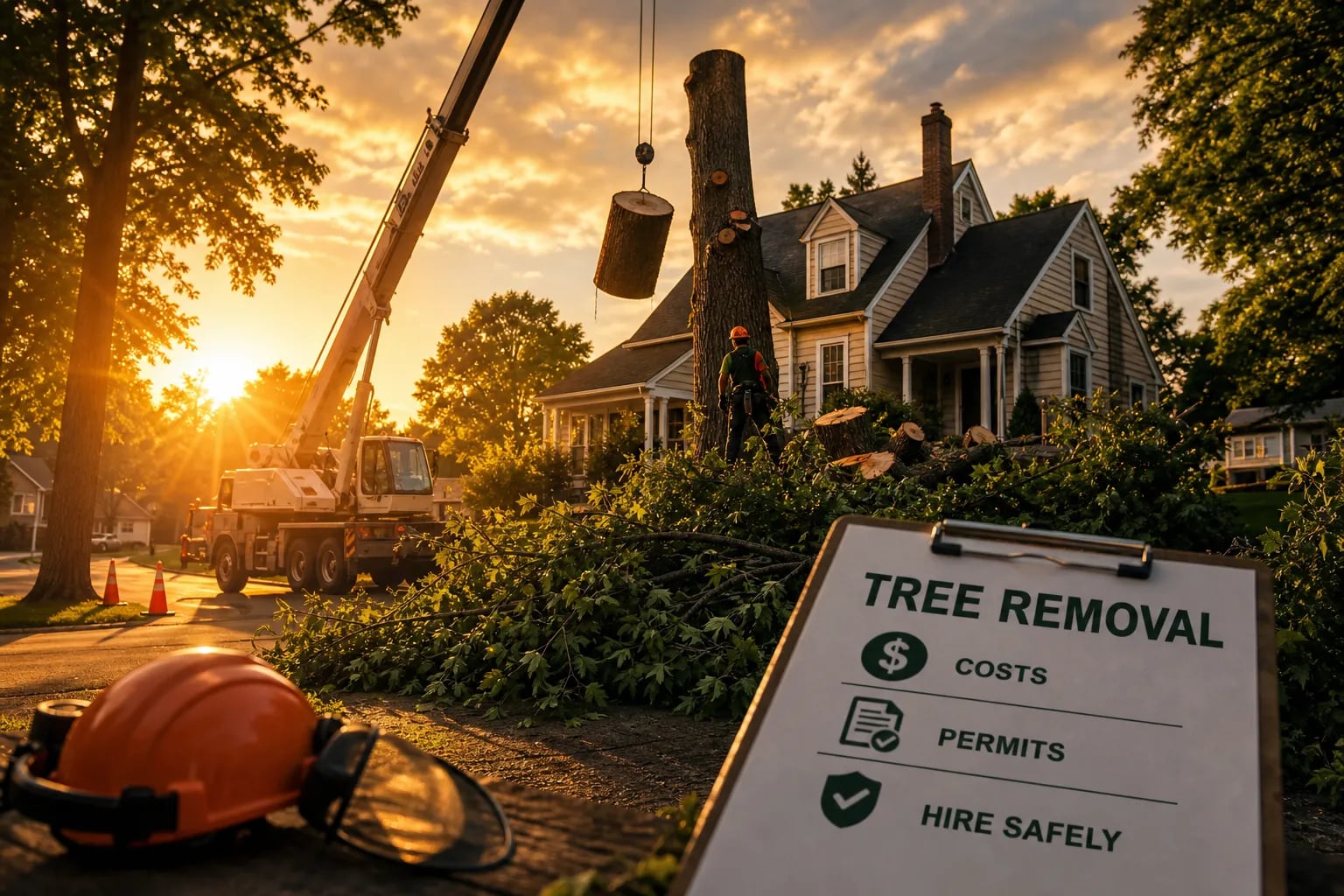
The process of tree removal works from the top down. Each section is cut and either guided to the drop zone with ropes and rigging, or for dangerous trees, hoisted by a crane. Once the tree has been removed down to a stump, the stump grinder machine is used by the tree removal crew to finish the job. Before the crew leaves, the site should be raked clean, debris hauled away and disposed at a recycling facility, and the stump ground to below grade. Just make sure not to trust a landscaper with your tree removal service, since safety protocols and proper procedures are often ignored.

How to Hire a Tree Removal Company You Can Actually Trust

Before you sign anything, run through this checklist to make sure you’re hiring a qualified, properly insured tree removal service.

Non-negotiable credentials and insurance to verify:

  • ISA Certified Arborist on staff or supervising the job
  • General liability insurance with at least $2 million in coverage
  • Workers’ compensation insurance covering all crew members
  • Dozens of Google 5-star reviews from customers

Also, if anything seems suspicious about the Arborist that you meet with, verify insurance by requesting a certificate directly from the insurer, not a copy provided by a suspicious estimator. For ISA certification, look up the Arborist by name or credential number through ISA’s public “Find an Arborist” directory. This credential belongs to the individual, not the company, so ask specific questions about the experience of the Certified Arborist employed by that company.

There are several red flags that consistently signal an unqualified crew. For example, if no written estimate is provided, or there’s pressure to start immediately without a signed contract, proceed with extreme caution. Also, cash-only payment demands, inability to provide a certificate of insurance, and refusal to give references are all serious warning signs of a shady tree service. Any company that recommends “topping” a tree as a pruning solution without a very specific safety reason is also revealing poor training. Topping a tree is widely condemned by Certified Arborists and causes long-term structural damage to the tree.

Local expertise and proper equipment matter more than price. Hiring a locally rooted, certified, and fully insured tree service protects you legally and financially if anything were to go wrong on the job site. Scottsdale Tree Trimmers is a family-owned business with nearly 20 years experience, Certified Arborists on staff, full insurance coverage, and professional equipment for every tree removal job. Free quotes are available with no obligation, and new customers receive a 15% discount, so there’s no reason to settle for a crew that cuts corners on safety to cut the price.

Ready to Get a Professional Assessment?

If you’ve spotted warning signs and know what to ask a tree removal company, you’re in a strong position to move forward with confidence. The key is acting before a declining tree becomes an emergency situation, because emergency tree removal always costs more, versus a tree being planned & scheduled for removal ahead of time.

Tree removal handled properly protects your property, your family, and your peace of mind. If handled poorly by a crew that lacks experience, it can create liability, property damage, and costs that far exceed what a qualified professional would have charged from the start.

If you have a tree you’re concerned about in Scottsdale, Paradise Valley Az, or anywhere across the Phoenix metro area, Scottsdale Tree Trimmers is ready to help. Looking for tree removal near me in the Phoenix, Paradise Valley or Scottsdale area? Call us today at (480) 435-2226 to schedule your free estimate. There’s no obligation, and you’ll walk away knowing exactly what your tree needs, what it costs, and what to expect for your tree removal service.

How to Get Your Landscape Ready for Summer

Summer is a time of pleasant changes. As the warmth of summer fades into the milder temperatures of autumn, it is imperative to think about the kind of things people want to get done. Part of the process of changing from one season to the next is paying attention to the home. A home should be pleasing to the eyes in every way. All areas of the home need care as the seasons go on. The outdoors are a particular area deserving of careful thought. Prepping your landscaping for Summer is easier than ever with a few simple and easy steps or working with a licensed, professional arborist.

Your Existing Plantings

Now is the time to take stock of your existing plantings along all areas of your yard. You might have lots of flowers in place already that have been in bloom since early spring. Many people also have lots of bushes and other kinds of greenery on their property. You’ll want to make sure the plantings you have look good to the eye. To that end, it helps to think about every kind of planting on your property. Take the time to walk across each part of your yard including the front and back.

Clearing Out Existing Debris

When Summer comes along, the leaves begin to turn colors. As they do, they also may begin to litter your property. Leaves can create issues that can lead to problems with the health of your lawn. You’ll want to make sure you have what it takes to head off leaves all over your yard. To that end, it’s best to have items like a rake on hand to help remove the leaves you don’t want. It’s also important to have items like bags on hand that allow you to manage those piles of leaves as you collect them.

Change in Flowers

Flowers add a lot of character to any yard. Summer is the perfect time to think about the kind of flowers you have on hand. If you have lots of flowers that are right for the hot weather, you’ll want to change them up. Now is the time to bring in those heartier flowers for Summer. You need flowers that can withstand the colder weather outside including the ice and the snow. Heartier flowers can be placed in your flower boxes and along the yard for a lovely seasonal look.

Getting Fencing in Shape

Fences can take a beating in the hot and humid weather. You need to examine those fence for evidence of any damage. The hot weather may have caused metal spikes to expand and areas of the fencing to come lose. It’s time to make sure your fencing can stand up to the demands of the ice and snow. Shoring up any fencing is an ideal way to protect your beloved landscaping from the ravages of the colder Summer and winter season. A few simple changes to the fencing can make sure your yard will look great.

The Lawn

The lawn, like the rest of your landscaping, needs a lot of attention once the weather shifts. This time marks the perfect time to bring in the new grass. Sowing grasses that work with the colder temperatures is easy. Turn to grasses like rye and fescue. They need little care to bring the lush looks you like best. It’s also the time of year to put down an additional layer of seasonal fertilizer to increase the nutrients that reach the ground. The lawn given this kind of care will reward you with truly lovely landscaping.

3 Signs Your Trees Need Professional Trimming

If you own property that has trees on it, one vital part of maintaining that property is making sure that these trees are correctly cared for. Otherwise, you run the risk of limbs falling and causing property damage, disease spreading to neighboring properties, and overgrowth hindering your ability to maintain your yard. There are numerous reasons to carefully maintain the trees on your property, or have a professional tree trimming company do so for you, including the following:

Trees are Overgrown

If the branches on the trees of your property aren’t pruned regularly, you can end up with two problems. One, they’ll grow too many branches that are too close together, and they could wind up needing to be topped – having all or most of the top of the tree removed. They could also wind up with too many branches sprouting from the trunk too low, making it difficult to walk around the tree or get close to it with a lawnmower. Overgrown trees are prone to disease, difficult to care for, and more likely to be damaged in a storm, as the branches are thinner and weaker.

Trees are Diseased

Trees on your property that are diseased or that have been infested by insects will also need to be treated or removed entirely. Otherwise, you run the risk of the contamination spreading to your other trees. It’s better to catch these issues early on before you have a much larger problem on your hands. If you aren’t sure how to handle the issue, it may be wise to reach out to a tree professional.

Storm Damage

After a severe winter storm or thunderstorm, it’s wise to walk your property and look for storm damage. You may find none, or you may find that the storm has brought down branches, or even entire trees. In these situations, you’ll need to have the damage taken care of immediately, especially if there’s a risk of more branches falling. If the damaged tree is near your home, outbuildings, or parking area, it’s especially important to monitor it carefully. In the winter, if you notice that snow and ice are causing specific branches to bend more than usual it may be worth paying extra attention to the tree to be sure you’re not at risk of it breaking or losing a limb during the next snowstorm.

Property owners should consider scheduling evaluations on an annual basis with a professional tree trimming contractor. These skilled individuals will visit your property, walk the entire area, and advise you about any pruning or tree removal that needs to be done. Then you can work out a plan together to handle any issues that they’ve noticed before they become emergencies. Taking care of the trees on your property isn’t a job that you have to do on your own. Instead, you can work with a local arborist to prevent damage, provide recommendations, and evaluate your trees for disease and damage. Contact one today to learn more about their services.