Edited & Published by Certified Arborist Dan Riggs
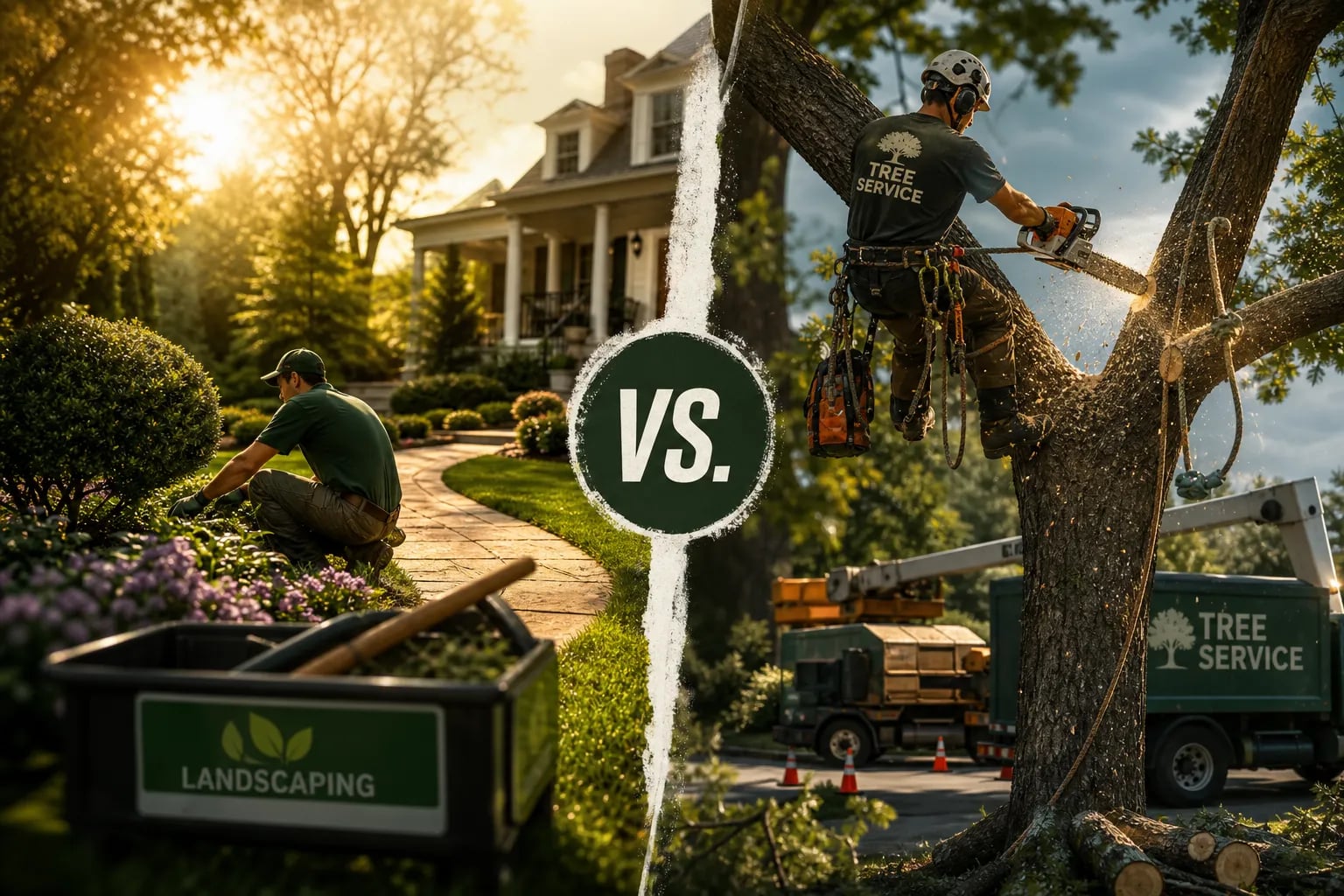
Your regular landscaping crew might offer to remove that large tree in your yard for a few hundred dollars. But the quote from the pro tree service in town is three times the cost. It might be tempting to just hire whoever is already on your property to save money. But when weighing the decision between landscaper vs. pro tree service, the choice gets clearer pretty quickly once you break down what you’re actually comparing (and the risks in making the wrong decision).
The gap between a landscaper and a professional tree service isn’t just a difference in price. It’s the difference in training, equipment, insurance, and the legal liability placed upon you if something goes wrong. For homeowners in Scottsdale, Paradise Valley, and the greater Phoenix area, the stakes are higher than average: desert trees like Mesquite, Palo Verde, and Eucalyptus behave differently than trees in other climates, and monsoon season and Arizona’s winter storms don’t care what (or who) is under a cracked branch. This article discusses exactly who should be making that call, and how to hire confidently after making your decision.
What Landscapers Are Actually Hired to Do
Landscapers can provide valuable work for your property, if you need your lawn mowed or your hedges trimmed. A reliable landscaping crew can keep your property looking sharp week to week, and that’s usually what they are able to do.
However, professional landscapers will stop the moment a tree gets large, structural, or complicated. Some crews can handle light cosmetic trimming on small ornamental trees, which is what a large, professional landscaping service is trained to do. But mature trees, structural crown work, heavy limb removal, and anything regarding tree health assessment are outside most landscaper abilities. Very few landscapers hold ISA certification, which may show a lack of commitment to their profession. And there’s an important distinction between tidying up a yard and properly pruning (or removing) a tree.
Landscaper vs. Pro Tree Service: Training, Equipment & Insurance
The ISA Certified Arborist credential is the benchmark for a professional tree care service in the United States. Earning it requires 5 years of documented arboriculture experience, passing a 200-question written exam, and ongoing continuing education classes to maintain active certification. The International Society of Arboriculture makes certification numbers publicly searchable, so you can verify any Arborist’s credentials before signing a contract. Any professional tree service company will have at least one Certified Arborist on staff, who is able to answer any questions or concerns that a property owner may have. And if you solicit a bid from a tree care company without a Certified Arborist on staff, it’s possible that the company is a landscaper dressed up as a pro tree service.
Equipment That Separates Landscapers from Pro Tree Service
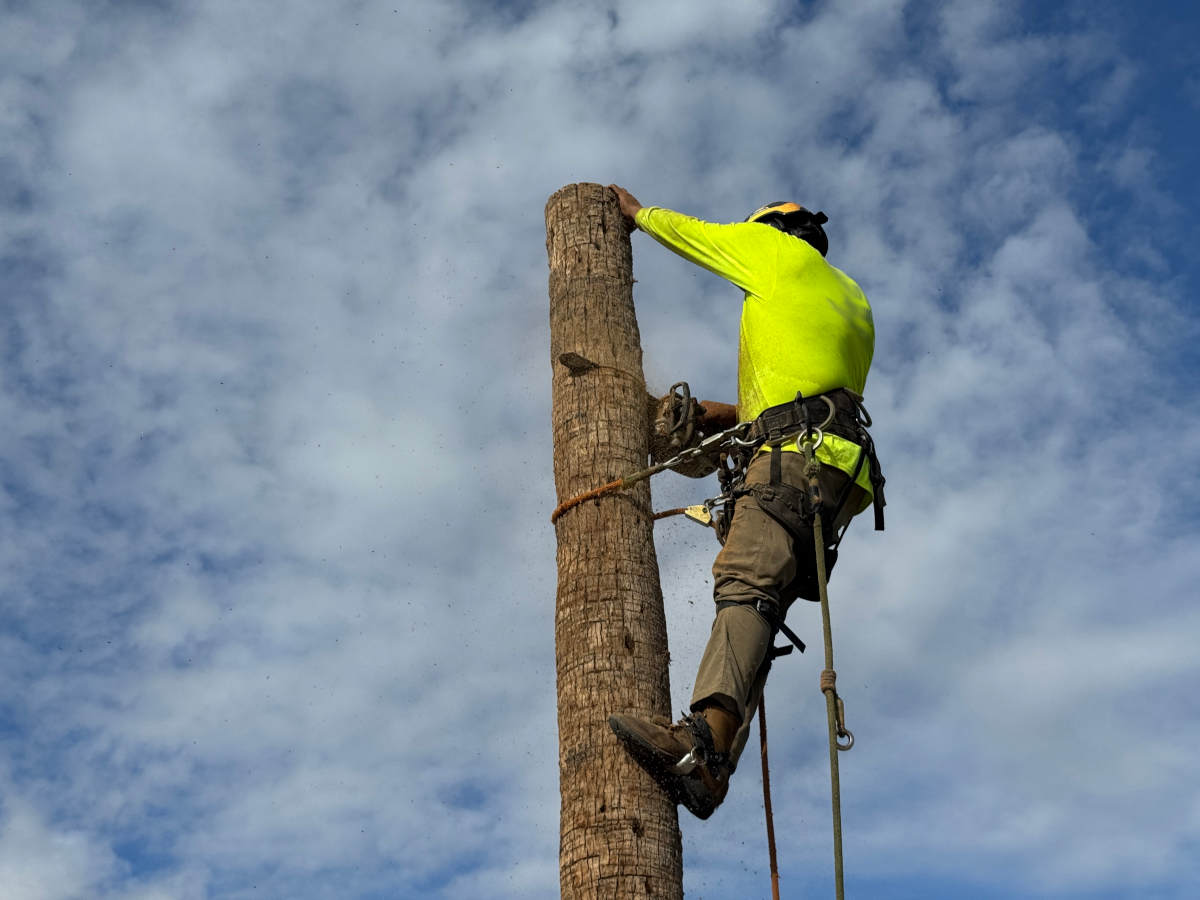
Equipment is another major dividing line. Large tree work may require aerial lifts, cranes to assist in tree removal for large or dangerous trees, and rope rigging systems to control where logs are lowered. Also commercial-grade wood chippers, and Arborist-specific PPE such as helmets and work boots. And this gear isn’t about convenience; it’s what allows crews to work safely near structures, rooflines, and fencing without causing property damage. Many professional tree services treat crane-assisted removal and complex rope rigging as standard methods for difficult residential and commercial jobs, not just a last-resort option.
The Safety and Liability Gap No Homeowner Should Overlook
Tree care is consistently ranked among the most dangerous occupations in the United States. The hazards on a large-tree service job are specific and serious: falls from height, injuries from falling branches, chainsaw accidents, and electrocution risk near power lines. And these aren’t just abstract statistics that only apply to commercial logging operations. They apply to the residential job in your backyard, with a crew that may or may not be equipped and trained to manage these risks.
The liability question is the most important. If a landscaper without proper insurance drops a limb through your roof or a worker gets hurt on your property, you may be stuck with the bill, if there isn’t Liability Insurance or Workers’ Compensation coverage in place. Before any tree work begins, request a certificate of general liability insurance sent directly from the insurer, not a document handed to you by the crew. Also, ask separately for proof of current workers’ compensation insurance coverage. Reputable tree companies will provide proof upon request, and ask their insurer to send the certificate directly to you. A contractor who pushes back on this request is telling you everything you need to know.
The injury risk scales with tree size, proximity to structures, and complexity of the job. A storm-damaged tree with a split trunk hanging over your pool carries a very different risk profile than trimming a hedge along your driveway. Treat the insurance verification process as a non-negotiable step, not an optional formality.
Tree Conditions That Call for Tree Pros, Not a Landscaper
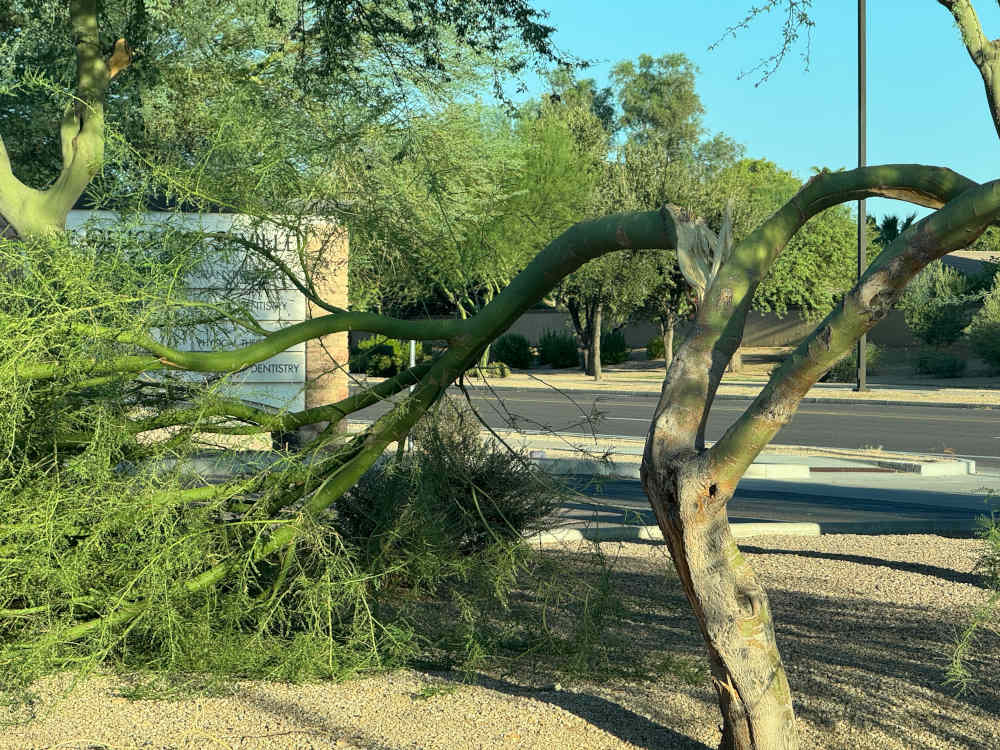
Certain conditions put a job firmly in pro tree service territory, regardless of what the landscaping crew says they are capable of. Disease symptoms are the first category: unusual leaf drop, bark discoloration or splitting, fungal growth near the base, dying branches throughout the crown, and oozing sap or gummosis. In Arizona’s desert climate, these signs are sometimes dismissed as heat stress, but they might indicate root rot, vascular disease, or pest damage that requires a trained diagnosis to treat or address safely.
Structural issues are the second category, and these carry the most immediate physical risk. Visible cracks in major limbs, a tree that is leaning, heaving soil within the root zone, cavities in the trunk, or branches failing without warning all signal that the tree may be in decline. These conditions require assessment from a professional tree service, not just a confident-sounding estimate from a guy with a chainsaw.
The high-risk scenarios that specifically require a professional tree service include:
- Trees with branches hanging over a roof, pool, fence line, or vehicle
- Storm-damaged trees with unpredictable structural failure points
- Large trees where rigging is required to control where logs are lowered with rope rigging
- Trees with root systems near a foundation or hardscape
- Any job requiring climbing or aerial lift access
Each of these scenarios requires not just skill, but also proper insurance coverage for the actual risks involved. A landscaper’s general liability policy rarely covers this scope of work.
Cost Comparison: Landscaper vs. Pro Tree Service
Professional tree work costs more than landscaper pricing for the same job, and the reasons are obvious. Standard tree pruning may cost between $400 to $800 per tree for typical residential work, with complex or large tree jobs costing more. Full tree removal might range between $450 to $1,200 on average, with large or difficult tree removals exceeding $2,000. Also, stump grinding service is usually quoted separately, and averages between $75 to $500 per stump, depending on the diameter. Emergency tree removal after storm damage can reach $2,000 or more when access is limited and the tree is unstable. These figures reflect national averages, but will vary by region, tree size, tree species and site conditions.
Landscaper pricing often comes in much lower because it doesn’t account for the equipment, insurance premiums, or credentialed oversight that professional tree services carry as fixed overhead costs. And it reflects a genuinely different cost structure for genuinely different capabilities.
The more useful comparison isn’t bid A versus bid B. It’s total risk versus total cost. Hiring a fully insured professional tree service eliminates financial risk, but homeowners should still verify coverage types, limits, and exclusions with the insurer directly. The upfront savings on the cheaper bid can disappear very quickly if something goes wrong, and in large-tree service work, there is always that risk by hiring a landscaping company.
What to Ask Any Company Before You Hire
There are four questions that separate qualified tree services from landscapers, and each one targets something that matters: credentials, insurance, standards, and job-specific experience. Walk through these before committing to anyone.
- Can you provide your ISA Certified Arborist’s number for verification? The ISA’s online tool lets you confirm that a credential is active (and not expired). A legitimate Arborist will give you this information without hesitation.
- Can your insurer send me a certificate of liability and workers’ compensation coverage directly? The key word is “directly.” Certificates that are handed to you by the crew can be outdated, altered or even fake. Ask the insurer to send it to you directly. Then confirm the coverage limits and policy details versus what was told to you by the tree service representative.
- What safety precautions does your company take? A pro tree service will always use safety practices on the job. A tree service company that focuses on safety is operating at the professional standard that your job requires.
- Which jobs have you done this specific type of work before? Diseased removals, crane work, storm damage, large trunks over a structure: each has its own risk profile. Ask the tree service representative you meet with to describe jobs they’ve performed that are similar to yours, and what safety precautions were taken.
When you’re uncertain about any part of this process, get a professional assessment first. Scottsdale Tree Trimmers offers free quotes with no obligation, and a tree service professional will walk you through exactly what the job involves before you’ve committed to anything. This assurance gives you real information to evaluate every other bid that you receive, rather than comparing prices without understanding the risks of accepting the lowest bid for your tree service project.
The Bottom Line on Who to Hire
For routine yard and landscape maintenance, a landscaper might be the right person to call. But for anything involving tree structure, tree health, safety near structures, or large tree removal, a professional tree service with multiple types of insurance is the only safe choice. And the gap between these two types of companies isn’t primarily about price. It’s about training, equipment, liability coverage, and what happens if a landscaper damages property (or gets hurt) on your job.
When deciding landscaper vs. pro tree service for trees or high-risk work, always choose an experienced, fully insured team. For homeowners in Scottsdale, Paradise Valley, and the greater Phoenix area, Scottsdale Tree Trimmers offers free quotes and employs ISA-Certified Arborists on staff with deep desert-specific tree experience. From routine crown cleaning on a Palo Verde to crane-assisted removal of a storm-damaged Eucalyptus threatening your home, the team is built to handle any tree issues on your property. Get a professional assessment by calling (480) 435-2226 before you commit to any company. The estimate is free, and it gives you the proper information to make the right call.